
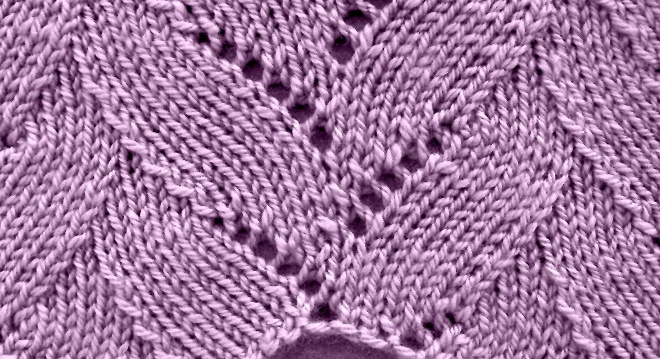
Look at the beautifully overlapping leaves in this falling leaves stitch pattern. The eyelets give it a modern, airy feel that works wonderfully in lightweight garments. This lace creates a wavy, organic texture where decreases and yarn-over increases combine to mimic leaves drifting on a breeze.
What you’ll need: Smooth light-colored DK yarn · US 6 (4mm) knitting needlesAs an Amazon Associate, KnitHit earns from qualifying purchases. It costs you nothing extra.
It’s rated as a moderately difficult lace — you’ll need to be comfortable with basic lace-forming techniques like yarn overs, slip-knit-pass decreases, and k2tog. If you’ve knitted a few simpler lace patterns before, you’re ready for this one.
The falling leaves stitch pattern makes a stunning finish on a stockinette stitch top, shawl, scarf, or blanket border. The 12-row repeat is easy to memorize once you get into the rhythm.
Pattern Details
Skill level: 3/4 Pattern repeat: Multiple of 22 stitches + 2 edge stitches Row repeat: 12 rows
Repeat the pattern between the asterisks until the desired width is reached. Work the right side following the instructions below. Purl all stitches on the wrong side (even rows).
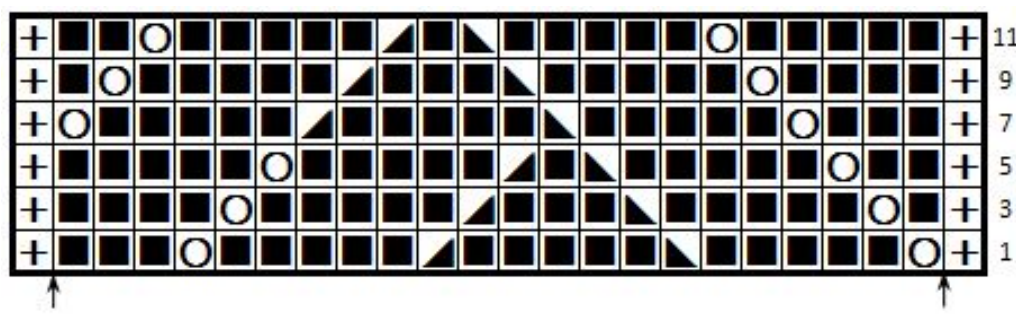
The chart below shows the 12-row repeat. Read odd rows from right to left, even rows from left to right. The two arrows mark the 22-stitch repeat between the edge stitches.
How to Read This Chart
- Each square represents one stitch on the right side of the work
- Filled square = knit (k)
- Open circle (○) = yarn over (yo) — creates a small hole/eyelet
- Right-leaning triangle = k2tog (decrease that leans right)
- Left-leaning triangle = sl1, k1, psso (decrease that leans left)
- Plus sign (+) = edge stitch (always knit)
- Read odd rows from right to left; all even rows are purled
Row-by-Row Instructions
Row 1: edge st, * yo, k5, (sl1 kwise, k next st, psso), k5, k2tog, k5, yo, k3 * repeat to last stitch, edge st
Row 2 and all even rows: Purl all stitches
Row 3: edge st, * k1, yo, k5, (sl1 kwise, k next st, psso), k3, k2tog, k5, yo, k4 * repeat to last stitch, edge st
Row 5: edge st, * k2, yo, k5, (sl1 kwise, k next st, psso), k1, k2tog, k5, yo, k5 * repeat to last stitch, edge st
Row 7: edge st, * k3, yo, k5, (sl1 kwise, k next st, psso), k5, k2tog, k5, yo * repeat to last stitch, edge st
Row 9: edge st, * k4, yo, k5, (sl1 kwise, k next st, psso), k3, k2tog, k5, yo, k1 * repeat to last stitch, edge st
Row 11: edge st, * k5, yo, k5, (sl1 kwise, k next st, psso), k1, k2tog, k5, yo, k2 * repeat to last stitch, edge st
Repeat rows 1 through 12 to continue the pattern.
Abbreviations
- k — knit
- yo — yarn over
- sl1 kwise — slip 1 stitch knitwise
- psso — pass slipped stitch over
- k2tog — knit 2 together
- edge st — edge stitch (knit or slip, depending on your preference)
Tips for This Pattern
The key to getting clean leaves is consistent tension on your yarn overs. If your eyelets look uneven, try going down a needle size — this tightens up the lace without losing the airy feel.
Blocking is essential for lace. Once your piece is finished, soak it in lukewarm water for 20 minutes, gently squeeze out excess moisture in a towel, and pin it flat to dry. This opens up the eyelets and reveals the full leaf pattern.
Project Ideas
This stitch pattern works beautifully for:
- Lightweight shawls — cast on 3-4 repeats wide for an elegant wrap
- Scarf panels — one repeat width creates a delicate scarf
- Sweater yoke accents — use a single repeat as a decorative band
- Blanket borders — add a few rows of falling leaves to frame a stockinette blanket
Recommended Supplies
Best yarn choice: A smooth, light-colored yarn in DK or fingering weight shows off the lace detail best. Wool-silk blends add beautiful drape. Dark yarns hide the eyelets, so stick to pastels or neutrals.
Needles: US 6 (4mm) for DK weight, or US 4 (3.5mm) for fingering weight. Use needles with pointed tips — they make the slip-knit-pass decreases much easier.
Get the supplies
- Smooth light-colored DK yarn on Amazonmerino blend – pale shades show the eyelets
- US 6 (4mm) knitting needles on AmazonClover Takumi bamboo, 9-inch single point
As an Amazon Associate, KnitHit earns from qualifying purchases. It costs you nothing extra.
You Might Also Like
- Larkspur Stitch — Another beautiful lace pattern with a delicate floral texture
- Maple Leaf Knitting Pattern — A nature-inspired ornamental motif that pairs perfectly with falling leaves