
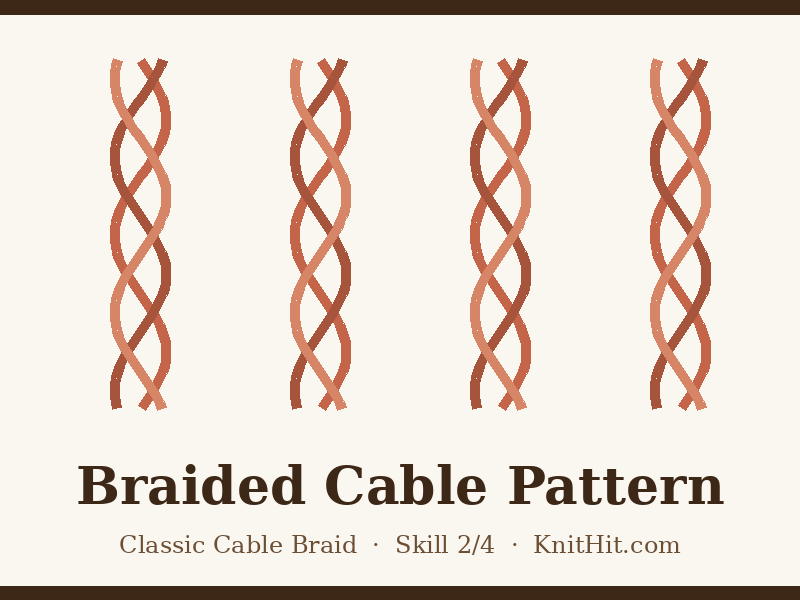
The braided cable knitting pattern looks like three knitted strands woven over each other in a continuous braid. It is a classic, simple cable that looks great on everything: the crossings come only every eighth row, so most of the knitting is plain ribs with the occasional satisfying cable turn.
If you can knit, purl, and work a basic 4-stitch cable, you can knit this braid. It is a perfect first step beyond a simple rope cable, and the columns of braids add rich texture to sweaters, hats, and blankets.
Pattern Details
Skill level: 2/4 Technique: Cables Stitch count: Multiple of 8 + 2 balance stitches, plus 2 edge stitches Repeat: 24 rows
Special Stitches: 4-Stitch Cables
4-st left cable (C4F): slip 2 stitches to a cable needle and hold in front, k2, then k2 from the cable needle.
4-st right cable (C4B): slip 2 stitches to a cable needle and hold in back, k2, then k2 from the cable needle.
The chart below shows one 8-stitch repeat plus the 2 balancing purl stitches. Edge stitches are not shown.
How to Read the Chart
- Read right-side (odd) rows from right to left
- Dotted squares are purled on right-side rows; blank squares are knit
- The diagonal lines show the 4-stitch cable crossings (solid strand crosses on top)
- Shaded wrong-side rows: work every stitch as it appears (knit the knits, purl the purls)
- New to charts? See our full guide on how to read knitting charts
Row-by-Row Instructions
Cast on a multiple of 8 stitches + 2, plus 2 edge stitches.
- Rows 1, 3, 5, 9, 11, 13, 17, 19, 21: edge st, *p2, k6*, repeat between *s, p2, edge st
- Row 2 and every even row: work stitches as they appear
- Rows 7 and 23: edge st, *p2, k2, 4-st left cable*, repeat between *s, p2, edge st
- Row 15: edge st, *p2, 4-st right cable, k2*, repeat between *s, p2, edge st
Repeat rows 1-24 to continue the pattern. See the knitting abbreviations reference for any shorthand used here.
Tips for a Neat Braid
Watch the crossing direction. The braid effect comes from alternating where the cable turns: rows 7 and 23 cross the left half of each braid to the front, row 15 crosses the right half to the back. If a braid looks twisted the wrong way, check which row you are on.
Cables pull the fabric in, so cast on more stitches than you would for stockinette of the same width, and expect to use roughly 15-20 percent more yarn. If the stitches next to the cable loosen, try wrapping the first purl stitch after a crossing a little tighter.
Project Ideas
- Sweaters and cardigans – braided columns are a timeless front-panel feature
- Hats – a ring of braids around the brim knits up fast
- Blankets and throws – the deep texture reads beautifully over large surfaces
- Scarves – braids framed by purl ribs lie flat and look great from a distance
- Pillow covers – the dense cable fabric holds its shape around an insert
Recommended Supplies
Best yarn choice: A smooth, plied worsted or aran weight yarn in a light or medium solid color gives the crispest braids. Wool has the elasticity cables love; avoid dark or fuzzy yarns that hide the crossings.
Needles: US 7-9 (4.5-5.5mm) for worsted to aran weight, plus a cable needle. Going down half a size keeps the braids firm and well-defined.
Get the supplies
- Worsted weight wool yarn on Amazon
- Cable needle set on Amazon
As an Amazon Associate, KnitHit earns from qualifying purchases. It costs you nothing extra.
You Might Also Like
- Twisted Cable – the natural next step in cable knitting
- Basket Weave Knitting Pattern – deep knit-and-purl texture without a cable needle
- How to Read Knitting Charts – master the symbols used in this pattern
- Browse all patterns