
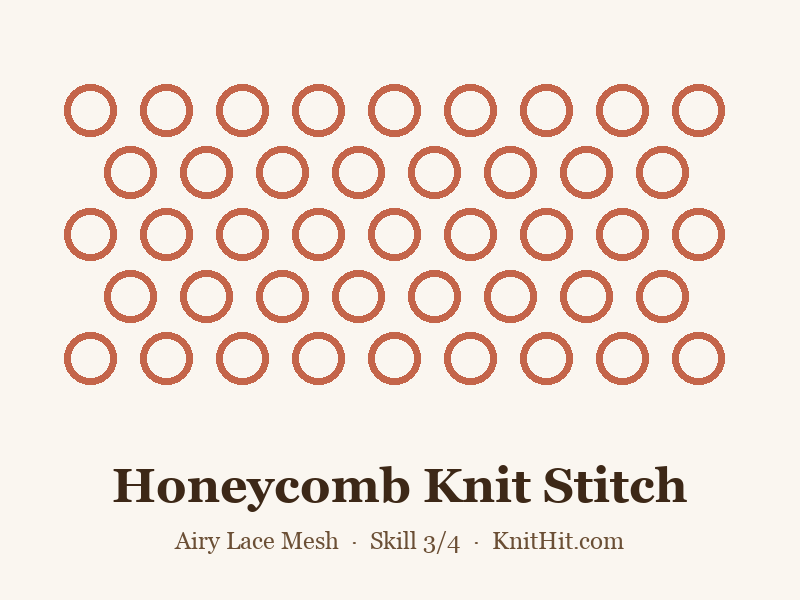
The honeycomb knit stitch produces an airy, delicate mesh that looks like rows of little cells in a honeycomb. It is a moderately challenging lace pattern built on a short 4-row repeat, so once the double yarn over clicks, it flows quickly off the needles.
Mesh stitches generally produce a one-sided fabric, but this honeycomb looks great on both sides, and either can face out. It is perfect for spring and summer projects: cardigans, boleros, tops, kids’ clothing, summer scarves, even a reusable market bag.
Pattern Details
Skill level: 3/4 Technique: Lace / mesh Stitch count: Multiple of 4 (minimum 8), plus 2 edge stitches Repeat: 4 rows
Special Stitch: Double Yarn Over
Double yarn over (2yo): wrap the yarn twice around the needle. On the next row, work (k1, p1) into each double yarn over. This is what opens up the large honeycomb cells.
The chart below shows two pattern repeats. Edge stitches are not shown. Purl one set-up row before starting the chart.
How to Read the Chart
- Read right-side (odd) rows from right to left
- Two adjacent circles = one double yarn over (2yo)
- Shaded wrong-side rows: work (k1, p1) into each double yarn over, purl all other stitches
- New to charts? See our full guide on how to read knitting charts
Row-by-Row Instructions
Cast on a multiple of 4 stitches (minimum 8), plus 2 edge stitches. Purl one row, then begin.
- Row 1: edge st, k1, k2tog, *2yo, sl1 knitwise-k1-psso, k2tog*, repeat between *s, yo, k1, edge st
- Row 2 and all even rows: edge st, work (k1, p1) into each 2yo, purl all other stitches, edge st
- Row 3: edge st, k1, yo, *sl1 knitwise-k1-psso, k2tog, 2yo*, repeat between *s, sl1 knitwise-k1-psso, k1, edge st
- Row 4: as row 2
Repeat rows 1-4 to continue the pattern. See the knitting abbreviations reference for any shorthand used here.
Tips for Knitting Lace Mesh
Use a lifeline. Thread a smooth contrasting yarn through the stitches after each completed repeat; if you drop a yarn over three rows later, you can rip back to the lifeline instead of starting over.
Count after every right-side row. Each repeat should come back to the same stitch count; a quick count catches a missed yarn over while it is still cheap to fix. Blocking is where mesh comes alive: wet block and pin the fabric open so every honeycomb cell shows.
Project Ideas
- Summer tops and boleros – the open fabric breathes beautifully in warm weather
- Scarves and shawls – lightweight and drapey with lovely stitch definition
- Market bags – the mesh stretches to hold far more than it looks like it should
- Kids’ clothing – airy layers for spring
- Curtain panels – an unexpected but charming use for a light-filtering mesh
Recommended Supplies
Best yarn choice: Smooth cotton, linen, or a light wool blend in fingering to DK weight. A tightly plied yarn keeps the yarn overs crisp; fuzzy yarns blur the honeycomb cells.
Needles: US 4-6 (3.5-4mm) for fingering to sport weight. Going up a needle size opens the mesh further for an even airier fabric.
Get the supplies
- Fingering weight cotton yarn on Amazon
- US 5 (3.75mm) knitting needles on Amazon
As an Amazon Associate, KnitHit earns from qualifying purchases. It costs you nothing extra.
You Might Also Like
- Falling Leaves Stitch Pattern – a graceful leaf lace with eyelets
- Larkspur Stitch Pattern – a flower lace inspired by Mediterranean larkspur
- How to Read Knitting Charts – master the symbols used in this pattern
- Browse all patterns