
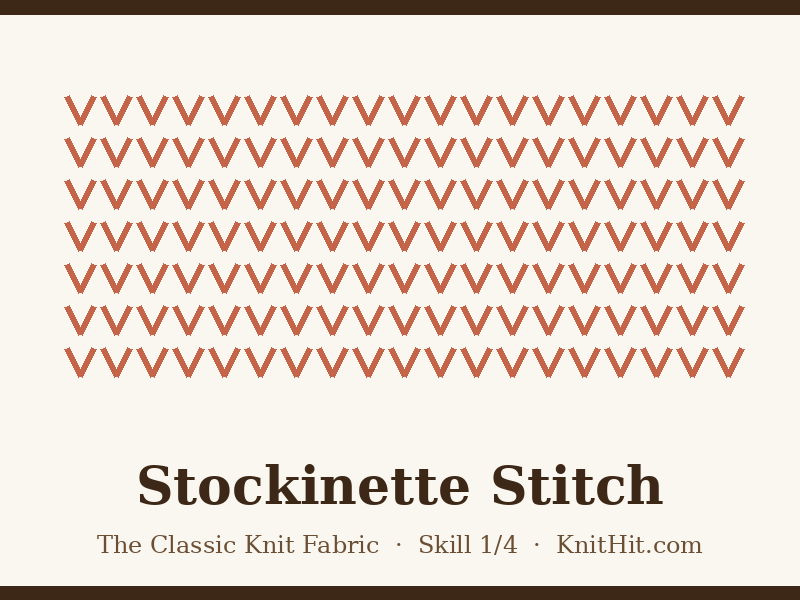
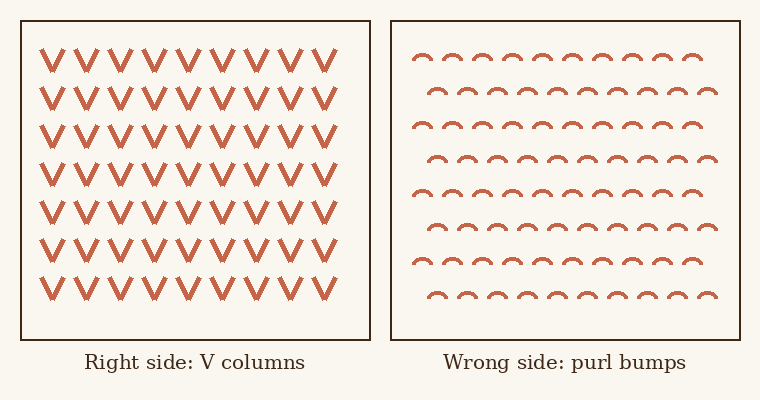
The stockinette stitch (also spelled stocking stitch, abbreviated St st) is the most widely used stitch pattern in knitting. It’s the smooth, classic fabric you see on most commercial knitwear — a surface of neat, interlocking “V” shapes on the right side, and a bumpy purl texture on the wrong side. Making stockinette is straightforward: knit one row, purl the next, repeat. In the round, it’s even simpler — just knit every round. This alternation of knit and purl rows creates the smooth face that makes stockinette the ideal canvas for colorwork, textured accents, and shaping. Stockinette is one of the first patterns you’ll learn, but it comes with one quirk every knitter needs to know about: the edges curl. The sides curl toward the back, and the top and bottom curl toward the front. This is natural and not a mistake — it’s caused by the different tension between knit and purl stitches. There are easy ways to manage it, which we’ll cover below.
Pattern Details
Skill level: 1/4 Pattern repeat: Any number of stitches Row repeat: 2 rows Fabric type: Smooth front, bumpy back, curls at edges
Row-by-Row Instructions
Flat knitting (back and forth):Row 1 (right side): Knit all stitches. Row 2 (wrong side): Purl all stitches. Repeat rows 1 and 2. Circular knitting (in the round):Every round: Knit all stitches. Knitting every round in the round produces stockinette because you’re always working on the right side of the fabric. Reverse stockinette: To get the bumpy purl side as your right side (used as a background for cables and textured patterns), simply reverse the instructions — purl on the right side, knit on the wrong side. Or just flip your stockinette over.
Abbreviations
k — knit p — purl St st — stockinette stitch
How to Fix Curling Edges
Curling is the number one frustration with stockinette. Here are proven solutions: Add a non-curling border. The most common fix. Knit 3-5 stitches in garter stitch or seed stitch at the beginning and end of every row, and work 3-5 rows of garter or seed stitch at the cast-on and bind-off edges. This frames the stockinette and keeps it flat. Block your finished piece. Wet blocking (soaking, pinning flat, and drying) relaxes the curl significantly. For wool, this can almost completely eliminate curling. Acrylic yarn doesn’t respond as well to wet blocking — use steam blocking instead. Use it strategically. The curl can be a feature, not a bug. Stockinette naturally rolls into tubes, which creates beautiful rolled edges on hats, necklines, and cuffs without any extra work. Knit it in the round. When you’re making a tube (socks, hat bodies, sleeves), curling isn’t an issue because there are no side edges. The cast-on and bind-off edges can be handled with ribbing.
Tips for This Pattern
The most common issue beginners face with stockinette is “rowing out” — alternating rows of tight and loose stitches that create visible horizontal lines. This happens when your purl tension differs from your knit tension (usually purls are looser). To fix rowing out, try purling with a needle one size smaller than your knit needle. Or practice keeping slightly more tension on your yarn when purling. Most knitters naturally even out their tension with practice. Another common beginner issue is accidentally adding stitches. This usually happens at the start of a purl row when the yarn is in front and you bring the needle through the first stitch — it can look like two stitches. Make sure you’re counting your stitches every few rows until you’re confident. If you’re struggling with the purl stitch, try Continental-style purling (holding the yarn in your left hand). Many knitters find this faster and more even than English-style (yarn in right hand) for purling.
Project Ideas
Stockinette is the foundation of most knitting projects: Simple hats — knit a tube in the round, decrease at the top. A stockinette beanie is a satisfying first project in the round. Sweater bodies — stockinette is the standard for sweater fronts, backs, and sleeves. Pair it with ribbing at the edges. Colorwork backgrounds — Fair Isle and stranded colorwork are knitted in stockinette. The smooth surface makes color patterns crisp and clear. Socks — the smooth fabric is comfortable against skin and shows off self-striping yarns beautifully. Swatches and practice pieces — always swatch in stockinette to check your gauge before starting a project. Your gauge in stockinette is your baseline measurement.
Recommended Supplies
Best yarn choice: Smooth, plied yarns in any weight showcase stockinette best. Merino wool creates a beautiful, defined fabric. For learning, worsted weight in a light color lets you see every stitch clearly. Variegated and self-striping yarns look fantastic in stockinette — the smooth surface is a perfect canvas for color changes. Needles: US 7 (4.5mm) for worsted weight, US 4 (3.5mm) for DK weight. Use whatever needle material feels comfortable — metal for speed, wood or bamboo for grip.
You Might Also Like
Garter Stitch — The simplest stitch, and a great non-curling border for stockinette projects Seed Stitch — A textured, reversible alternative when you need a flat fabric
Get the supplies
- Worsted weight yarn on Amazon
- US 8 (5mm) knitting needles on Amazon
As an Amazon Associate, KnitHit earns from qualifying purchases. It costs you nothing extra.