
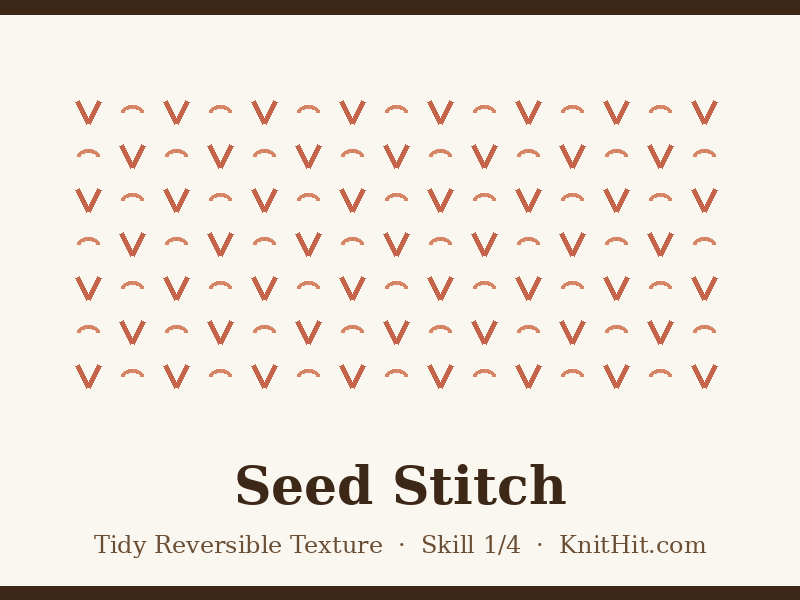
The seed stitch (also called moss stitch in the UK) creates a beautiful, pebbly texture that looks like scattered seeds across the fabric. It’s made by alternating knit and purl stitches in a checkerboard pattern — wherever you knitted on the previous row, you purl, and vice versa. This simple alternation produces a dense, firm fabric with a lovely bumpy texture on both sides. Like garter stitch, seed stitch is fully reversible and lies completely flat without curling, which makes it ideal for borders, scarves, and any project where both sides need to look good. Seed stitch is the natural next step after you’ve mastered knit and purl stitches separately. It teaches you to read your knitting — recognizing which stitches are knits and which are purls as they sit on your needle — which is one of the most important skills you’ll develop as a knitter.
Pattern Details
Skill level: 1/4 Pattern repeat: Multiple of 2 stitches (use an odd number for easiest version) Row repeat: 2 rows Fabric type: Reversible, textured, non-curling, dense
Row-by-Row Instructions
Version 1 — Odd number of stitches (easiest):Every row: * k1, p1 * repeat to last stitch, k1. When you use an odd number of stitches, every row is identical. The knits and purls automatically stagger because the row starts and ends with the same stitch. Version 2 — Even number of stitches:Row 1: * k1, p1 * repeat to end. Row 2: * p1, k1 * repeat to end. Repeat rows 1 and 2. The rule is simple: knit the purls and purl the knits. Look at each stitch as it faces you — if it has a smooth “V” shape, purl it. If it has a horizontal bump, knit it. Circular knitting (in the round, even number of stitches):Round 1: * k1, p1 * repeat to end. Round 2: * p1, k1 * repeat to end. Repeat rounds 1 and 2.
Abbreviations
k — knit p — purl k1, p1 — knit one stitch, purl one stitch
Seed Stitch vs. Ribbing — What’s the Difference?
Seed stitch and 1×1 ribbing use the exact same stitches (k1, p1), but they look completely different. The difference is whether you stack or stagger them: In 1×1 ribbing, you knit the knits and purl the purls (same stitch above same stitch), which creates vertical columns that stretch sideways. In seed stitch, you knit the purls and purl the knits (opposite stitch above each stitch), which creates the bumpy, non-stretchy texture. If your seed stitch accidentally looks like ribbing, you’re repeating the same row instead of alternating. Check that you’re reading your stitches correctly.
Tips for This Pattern
The biggest challenge with seed stitch is maintaining even tension when switching between knit and purl stitches within the same row. The yarn moves from back to front (for purl) and front to back (for knit) on every single stitch, which can create loose spots. To keep your tension even, make sure you bring the yarn firmly between the needles (not over them) when switching from knit to purl and back. After a few rows, you’ll develop a rhythm. A common mistake is forgetting to move the yarn to the correct position before the next stitch. If you knit with the yarn in front, you’ll accidentally create a yarn over (an extra stitch with a hole). If your stitch count keeps growing, this is likely the cause. Using an odd number of stitches (version 1) eliminates the need to remember which row you’re on. Every row is the same, which makes it almost as mindless as garter stitch once you get going.
Project Ideas
Seed stitch works wonderfully for: Coasters and placemats — the dense, flat fabric is perfect for items that need to lie flat on a table. Cast on 25 stitches in cotton for a coaster. Hat bands and cuffs — seed stitch makes a non-curling alternative to ribbing at the edges of hats and sleeves. It’s less stretchy than ribbing, giving a more structured look. Phone cases and pouches — the dense, firm fabric protects your device. The texture also adds grip. Scarves and cowls — fully reversible with no wrong side, and it won’t curl like stockinette scarves do. Blanket borders — combine a stockinette center with seed stitch borders for a classic look that stays flat without blocking. Washcloths — the bumpy texture provides gentle exfoliation. A seed stitch washcloth in cotton yarn is a quick, practical project.
Recommended Supplies
Best yarn choice: A smooth, plied yarn in worsted or DK weight shows the bumpy texture best. Cotton and cotton blends are great for home items. Wool works well for garments. Avoid single-ply yarns — they tend to pill faster with the constant knit-purl switching. Needles: US 6-7 (4-4.5mm) for worsted weight. Seed stitch tends to be tighter than stockinette, so you may want to go up a needle size from what the yarn label suggests.
You Might Also Like
Garter Stitch — Even simpler, and just as versatile Twisted Cable — Ready to level up? Cables add a bold, three-dimensional texture
Get the supplies
- Worsted weight cotton yarn on Amazon
- US 7 (4.5mm) knitting needles on Amazon
As an Amazon Associate, KnitHit earns from qualifying purchases. It costs you nothing extra.