
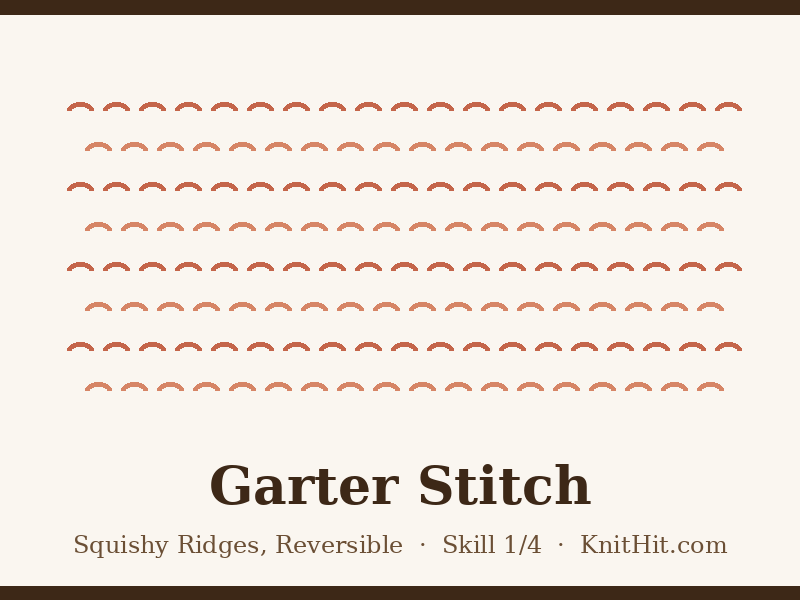
The garter stitch is where every knitter begins, and for good reason. It’s the simplest stitch pattern in knitting — just knit every stitch on every row — yet it creates a beautifully textured, squishy fabric that lies flat without curling. What makes garter stitch special is that it looks the same on both sides (it’s fully reversible), which makes it perfect for scarves, blankets, and anything where both sides will be visible. The fabric has a distinctive ridged texture with gentle horizontal lines, and it’s stretchier than stockinette in both directions. Don’t let its simplicity fool you — garter stitch is used by experienced knitters everywhere. It’s the go-to background for showcasing colorwork, the perfect border to prevent curling on stockinette pieces, and a meditative, relaxing knit when you want to work without thinking.
Pattern Details
Skill level: 1/4 Pattern repeat: Any number of stitches Row repeat: 1 row (every row is the same) Fabric type: Reversible, textured, non-curling
Row-by-Row Instructions
Flat knitting (back and forth):Every row: Knit all stitches. That’s it. Every row is a knit row. Two rows of knitting create one visible “ridge” on the fabric. Circular knitting (in the round):Round 1: Knit all stitches. Round 2: Purl all stitches. Repeat rounds 1 and 2. Note: When knitting in the round, you must alternate knit and purl rounds to get garter stitch. Knitting every round in the round produces stockinette, not garter.
Abbreviations
k — knit p — purl (only needed for circular knitting)
Understanding the Fabric
Garter stitch creates a fabric with these characteristics: Each “ridge” you see is made of two rows. So if you count 10 ridges, you’ve knitted 20 rows. This is useful when measuring your progress or matching pieces. The fabric is thicker and squishier than stockinette because the purl bumps on alternate rows push the fabric outward on both sides. This also means garter stitch uses more yarn per inch of length than stockinette. The gauge (stitches and rows per inch) is different from stockinette. Garter stitch is typically wider and shorter — you’ll get fewer rows per inch but a similar number of stitches per inch. Always swatch in garter if your project calls for it.
Tips for This Pattern
Even though garter stitch is simple, keeping even tension takes practice. The most common beginner issue is that edge stitches look loose and messy. To fix this, try slipping the first stitch of every row purlwise with yarn in front, then knitting the rest normally. This creates a neat chain-like selvedge edge. If your fabric looks uneven with alternating tight and loose rows, you’re likely knitting at different tensions on different rows. This evens out with practice — try to keep a relaxed, consistent grip on the yarn. Counting rows in garter stitch is easy once you know the trick: each raised ridge equals two rows. Count the ridges and multiply by two.
Project Ideas
Garter stitch is incredibly versatile: Beginner scarves — cast on 30-40 stitches in a chunky yarn and knit until it’s long enough. Your first finished project in an afternoon. Dishcloths and washcloths — a garter stitch square in cotton yarn makes a practical, textured cloth. Cast on 40 stitches, knit until square, bind off. Baby blankets — garter stitch is soft, squishy, and safe (no holes for tiny fingers). Use a soft acrylic or cotton blend. Borders and edges — add 4-6 rows of garter stitch at the top and bottom of stockinette pieces to prevent curling. Striped projects — garter stitch is perfect for color stripes because you can change colors every 2 rows without cutting yarn, and the color transitions look clean.
Recommended Supplies
Best yarn choice: Literally any yarn works for garter stitch. For learning, choose a smooth, light-colored worsted weight yarn — you’ll be able to see your stitches clearly. Avoid dark colors and fuzzy yarns when you’re starting out. Needles: US 7-8 (4.5-5mm) for worsted weight yarn. Bamboo or wooden needles give more grip than metal, which helps when you’re learning because stitches are less likely to slide off.
You Might Also Like
Seed Stitch — The natural next step from garter, adding purl stitches for a dotted texture Falling Leaves Stitch Pattern — Ready for a challenge? Try this beautiful lace pattern
Get the supplies
- Worsted weight yarn on Amazon
- US 8 (5mm) knitting needles on Amazon
As an Amazon Associate, KnitHit earns from qualifying purchases. It costs you nothing extra.