
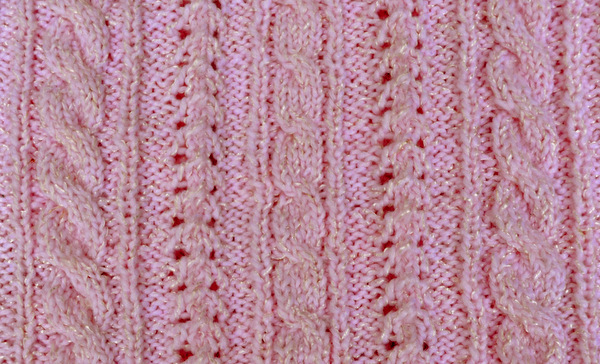
This twisted cable knit pattern features two bold cable columns that alternate their crossing direction, creating a rhythmic, rope-like texture with real visual depth. It’s complemented by a generous knit background that lets the cables stand out. This is a classic cable pattern that looks right at home on a gentleman’s sweater, but works just as well on cushions, scarves, and blankets.
What you’ll need: Worsted weight wool yarn · A cable needleAs an Amazon Associate, KnitHit earns from qualifying purchases. It costs you nothing extra.
The alternating crossings give this cable a more dynamic, “twisted” appearance compared to a simple rope cable where both columns cross in the same direction on the same row.
Pattern Details
Skill level: 3/4 Pattern repeat: Multiple of 20 + 2 + 2 edge stitches Row repeat: 45 rows Cable type: 8-stitch right cable (slip 4 stitches to cable needle, hold in back, k4, k4 from cable needle)
Work the right side following the instructions below. On wrong side rows, work all stitches as they appear (knit the knits, purl the purls).
How to Read This Chart
- Each square represents one stitch on the right side of the work
- Filled square = knit (k)
- Dash (—) = purl (p)
- Open circle (○) = yarn over (yo) — creates a small hole/eyelet
- Filled triangle = k3tog (knit three together — a double decrease)
- Plus sign (+) = edge stitch (always knit)
- Six-cell crossed block = 6-stitch right cable: slip 3 stitches to a cable needle and hold in back of work, knit the next 3 stitches, then knit the 3 from the cable needle
- Read odd rows from right to left; on even rows, work each stitch as it appears (knit the knits, purl the purls)

Row-by-Row Instructions
Rows 1, 7, 29, 35, 41: edge st, * p2, 8-st right cable, p2, k8 * p2, edge st
Row 2 (and every even row): Work stitches as they appear
Rows 3, 5, 9, 13, 15, 19, 21, 25, 27, 31, 33, 37, 39, 43: edge st, * p2, k8, p2, k8 * p2, edge st
Rows 11, 17, 23, 45: edge st, * p2, k8, p2, 8-st right cable * p2, edge st
Repeat the 45-row pattern to continue.
How to Work the 8-Stitch Right Cable
- Slip the next 4 stitches onto a cable needle and hold it at the back of your work
- Knit the next 4 stitches from the left needle
- Knit the 4 stitches from the cable needle
This creates a cable that crosses to the right. The pattern alternates which column gets cabled on which rows, producing the twisted effect.
Abbreviations
- k — knit
- p — purl
- 8-st right cable — see cable instructions above
- edge st — edge stitch
Tips for This Pattern
The 45-row repeat is long, so keep a row counter handy or use a knitting app to track your progress. The cable crossing rows are spaced 6 rows apart, which gives you plenty of plain knitting between crossings to relax into the rhythm.
For neater cables, try pulling the first stitch after a cable crossing slightly tighter than usual. This closes the small gap that sometimes forms at the base of the cable.
If you don’t own a cable needle, you can use a double-pointed needle (DPN) in a size smaller than your working needles — the smaller diameter keeps the held stitches from sliding off.
Project Ideas
This bold cable works well on larger pieces where the texture can really shine:
- Sweaters and pullovers — the classic home for this pattern. Center a panel on the front or run cables down both sleeves
- Scarves and cowls — one or two repeats wide creates a rich, textured scarf
- Cushion covers — cable panels paired with reverse stockinette make elegant throw pillows
- Blanket panels — alternate cable panels with simpler stitches for an heirloom-quality blanket
- Headbands and ear warmers — a single cable repeat makes a quick, satisfying accessory
Recommended Supplies
Best yarn choice: A plump, round wool yarn in worsted or aran weight makes cables pop. Smooth yarns like merino show cable definition better than fuzzy or textured yarns. Solid colors work best — cables get lost in variegated or multicolor yarns.
Needles: US 7 (4.5mm) for worsted weight, US 8 (5mm) for aran. Plus a cable needle or spare DPN one size smaller.
Get the supplies
- Worsted weight wool yarn on Amazonsolid colors – cables get lost in variegated
- A cable needle on AmazonClover U-shaped cable stitch holders
- US 7 (4.5mm) knitting needles on AmazonClover Takumi bamboo, 9-inch single point
As an Amazon Associate, KnitHit earns from qualifying purchases. It costs you nothing extra.
You Might Also Like
- Maple Leaf Knitting Pattern — A colorwork ornamental motif for nature-inspired projects
- Larkspur Stitch — Try a delicate lace pattern for a lighter, airier look